Sustainable Workflows
How Simplifying Your Tools Gives You Focus And Freedom
A new tool can feel like the answer, until you have a pile of them. Here's how I decide what stays, what goes, and what waits, so your business feels lighter.
Read The PostProductivity

Some weeks just fly by. You answer messages, show up for your clients, and keep a dozen things moving, and by Friday you're left wondering what you even worked on.
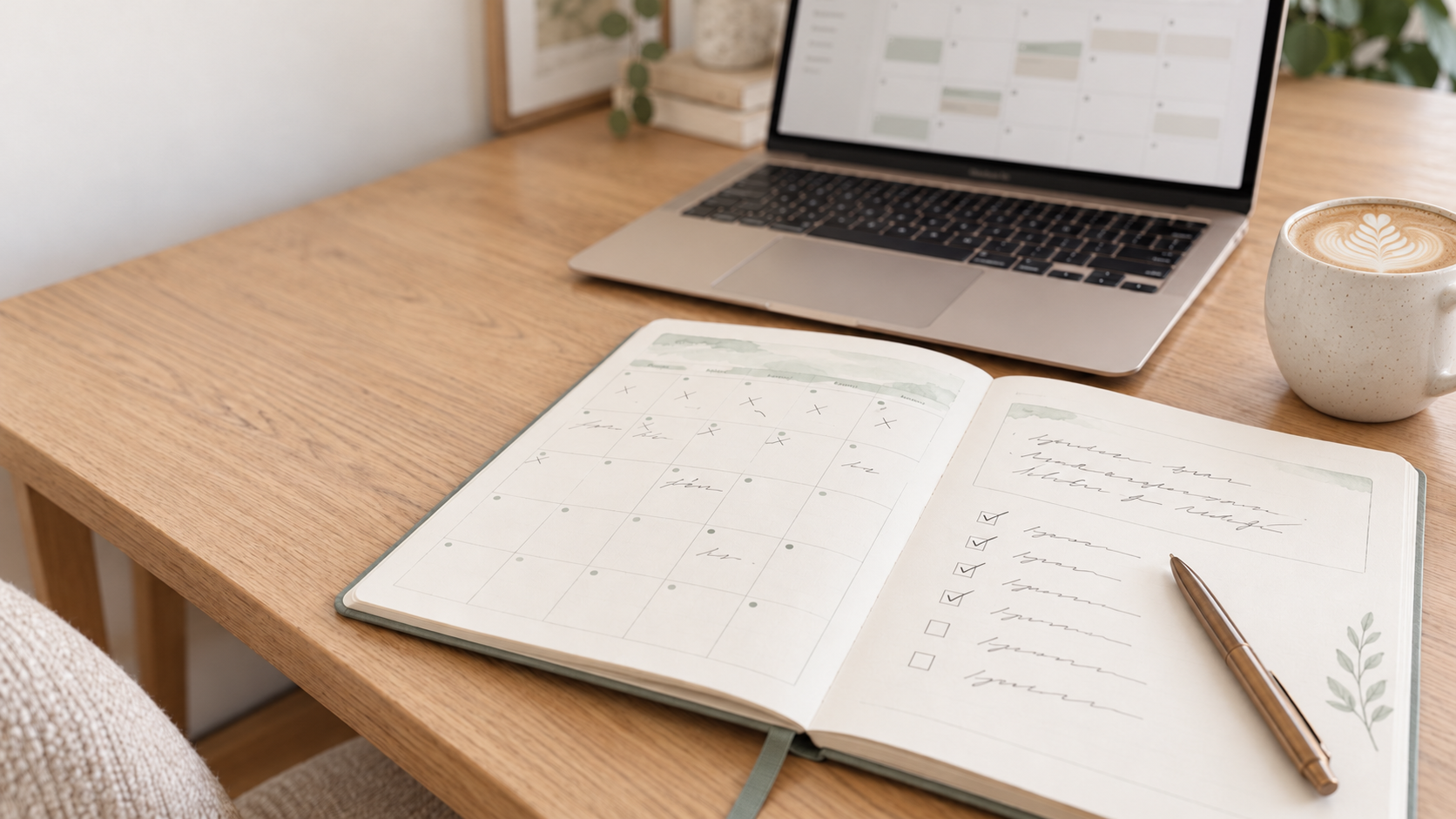
What I've found helps me the most is a weekly reset and planning ritual, a regular time to look back at my week, reset how I feel, and plan what's next, especially on the weeks that feel unproductive.
The tricky part is that a ritual that works beautifully for someone else may not work for you.
Busy weeks can hide their own progress, because you're moving so fast through so much that the finished things start to blur together. The loud things stick, and the quiet wins slip away. I wrote more about this in how to see the progress you made in a busy week.
A weekly ritual gives you one moment to look back, so the week doesn't just disappear.
My Own Ritual
I've had a weekly reset and planning ritual for a while, and it lived in Notion. Every week I pulled up each piece myself, opened a lot of tabs, and did mental gymnastics to put it all together in my head. Even for me, it was getting to be a lot.
After a long, tired week, I just wanted time with my family, not another sit down at the computer to gather everything up. So I recently redid the whole thing with an AI helper.
Now it gathers what I need in one place and shows me what's been piling up in my Notion, so I can come in as the CEO and make the decisions.
A ritual only works if you can keep doing it on your lowest energy week, and what's doable looks different for everyone. Even the experts don't agree on what a weekly review should look like.
David Allen, author of Getting Things Done, calls the weekly review the "critical success factor" of his method, and his team recommends one to two hours for the full eleven steps. Brian Moran and Michael Lennington, authors of The 12 Week Year, suggest about 15 or 20 minutes at the start of each week to review your progress and plan the next one.
Both are great, and each would feel very different on a tired Sunday.
"You do not rise to the level of your goals. You fall to the level of your systems."
James Clear, Atomic Habits
Does a weekly review have to be long to work? Not at all. The review itself is valuable, and the shape of it is yours to choose, so start with the version you could still do on your most tired week.
I do mine on Sunday, so I get some time away from work first, and it takes me about 20 minutes with three big jobs: close out the week, reset, and plan the week ahead.
What day of the week should I do weekly planning? I do mine on Sunday, since giving myself time away from work first means I reflect and plan with a clearer head. The best day is whenever you can look back without it feeling like more work.
Let the helper do the gathering so you can do the deciding. I wanted to be the CEO who comes in, sees the whole picture, and steers, not the one who spends her energy collecting it. CEO time is one of my weekly non-negotiables for exactly this reason.
Design it for your lowest energy week. I built mine to work even on my busiest, most chaotic days, and when my energy is low.
Keep your goals few and well rounded. I keep three goals, one each for revenue, visibility, and fulfillment, so my effort reaches the most important parts of my business. Cal Newport's first principle in Slow Productivity is to do fewer things, and The 12 Week Year keeps goals to a small number for a short stretch. I combined them and added my own spin.
I also like that The 12 Week Year tracks your effort separately from your results. Seeing both helps me know when it's time to pivot, and it keeps me accountable.
"Accountability is not consequences; it's ownership."
Brian Moran and Michael Lennington, The 12 Week Year
Ask yourself a few simple questions about when you can look back, what you want to see, and what you'd like help with, then build the smallest version that still works on your lowest energy week.
What should I include in a weekly review? Keep it to a quick pulse check. It gives you a feel for how your week went before you step into the next one, so there's no need to dig deep into your numbers, redo your messaging, or dream up a new offer.
Start with the smallest version of your weekly look back, and let your days give it a strong starting point.
My days are bookended by two things. Each morning, a daily brief runs on a schedule and shows me what my day looks like, including my meetings and to-dos and how they fit into my bigger picture. That way I don't accidentally spend my day on small things that feel productive but aren't moving me forward. Then at the end of the day, I do a daily check in journal.
My weekly ritual pulls from both of those. That means I'm not trying to remember an entire week on Sunday, which matters most when a lot happened or I'm feeling mentally and physically worn out, because I just won't remember it all. My days have already built a foundation for me to pull from.
Your week held more than your memory shows, and a ritual that fits you helps you see it. Start small, and let it become yours.
Free. Takes 2 to 3 minutes, and your result comes to your inbox.
Sustainable Workflows
A new tool can feel like the answer, until you have a pile of them. Here's how I decide what stays, what goes, and what waits, so your business feels lighter.
Read The PostSustainable Workflows
When you work without a team, every task lands on you. Tie your list to a 90-day goal and a weekly focus, and your week feels lighter.
Read The PostProductivity
Busy all week but not sure what moved forward? Here's how to see your progress across marketing, sales, fulfillment, and CEO work, even on scattered weeks.
Read The Post