
Sustainable Workflows
How Solopreneurs Can Stop Feeling Overwhelmed by Their To-Do List
When you work without a team, every task lands on you. Tie your list to a 90-day goal and a weekly focus, and your week feels lighter.
Read The PostSustainable Workflows
If you're like me, you can look at a new tool and feel it right away: maybe this is the one that finally makes everything easier. That feeling comes from caring about running your business well, and it's also how a few helpful tools slowly turn into a pile of them.
Simplifying your business tools gives you more focus, because every switch between tools leaves part of your attention behind. Cal Newport explains this in his book Deep Work (2016), building on research by business professor Sophie Leroy. He calls it attention residue. Fewer, carefully chosen tools mean fewer switches, which leaves more of you for the work and people you love.
You can still have powerful, flexible tools. You just choose a few trusted places on purpose, so your business feels lighter and your mind has more room.
Simplifying means choosing on purpose. Fewer tools can make you more capable, since each one has a clear job and you actually know how to use it. Cal Newport's book [Slow Productivity](EXTERNAL LINK: https://www.penguinrandomhouse.com/books/722732/slow-productivity-by-cal-newport/9780593544853/) (2024) is built on three ideas, and the first is to do fewer things.
Many of us worry that cutting back will box us in. In my experience it works the other way around. When you aren't juggling a dozen places, you stop spending your energy on remembering where things live, and you have it ready for the work that moves your business forward.
A tool doesn't need to be the most powerful one out there. It just needs to earn its place. If you're still sorting out what deserves your attention first, my post on [deciding what to focus on next](INTERNAL LINK: How To Decide What To Focus On Next In Your Business) is a good companion.
Because every extra tool adds small costs that pile up quietly. For me they show up in four ways: context switching, tools that don't talk to each other, trying to remember where something lives, and paying for several things at once.
Context switching means moving your attention from one task or tool to another. Sophie Leroy's research, which Cal Newport shares in Deep Work, found that part of your attention stays on the earlier task after you switch, and that can make the next task harder to do well.
The other three are easier to feel than to measure. You open three places to find one note. You type the same thing twice. You pay every month for something you use a couple of times.
None of it is a big deal alone, but together it adds up to a tired mind. If your to do list already feels heavy, my post on [easing the overwhelm of your to do list](INTERNAL LINK: How Solopreneurs Can Stop Feeling Overwhelmed by Their To-Do List) can help.
Pause and check in with a few honest questions before you say yes. I ask four:
Together they point you toward one of three answers: start it, test it, or save it for later.
Cost is part of that, and I don't only look for the cheapest or free option. I look for the best bang for my buck, which means how well something fits with everything else I use.
Notice how you feel, because your first reaction is an important clue. That's true even when someone you trust swears by a tool, raves about it, or there's a special deal attached.
Pay attention to how you feel as you start to research it, too. Does it make you curious and a little lighter? Or do you start to feel overwhelmed and wonder, "But how would this fit in?" Both are worth noticing.
A glowing review or a good price can make something feel exciting before you've had a chance to think. Slowing down long enough to feel your own reaction helps you tell the difference between being excited about the tool and being excited by the buzz around it. If you like to write things down, my post on [building a business journal](INTERNAL LINK: How To Build A Business Journal That Feels Like You) is a gentle place to capture these reactions.
Choose the tool that does your main job and works with how you operate, even when another one looks more impressive. I think about a tool as a whole: what its job is, what it's doing for me, and how it fits my goals, my workflows, and how I like to work.
A tool can be less powerful, or less pretty, and still be the right one if it does the main thing you need and supports your flow. One that is better on paper but interrupts that flow costs you more than it gives.
You're also allowed to pause. Pausing keeps the door open while you give an idea a fair look and compare it with what you already use. That has led me to say no more often, and I feel more confident in each no, because I know why it isn't the right fit right now. When it's a yes, I know that too.
A simple tracker puts every tool in one place, with what it costs and what it does for you. I built one for my own business, and it helped me be more intentional right away. Each tool has a place and a purpose, so I can see whether it is earning its spot.
You don't need anything fancy. A list with a few columns works: the tool, its job, what it costs each month, and how it connects to the rest of your workflow.
When something new catches your eye, you can hold it up against your list and see where it would fit and what it would replace.
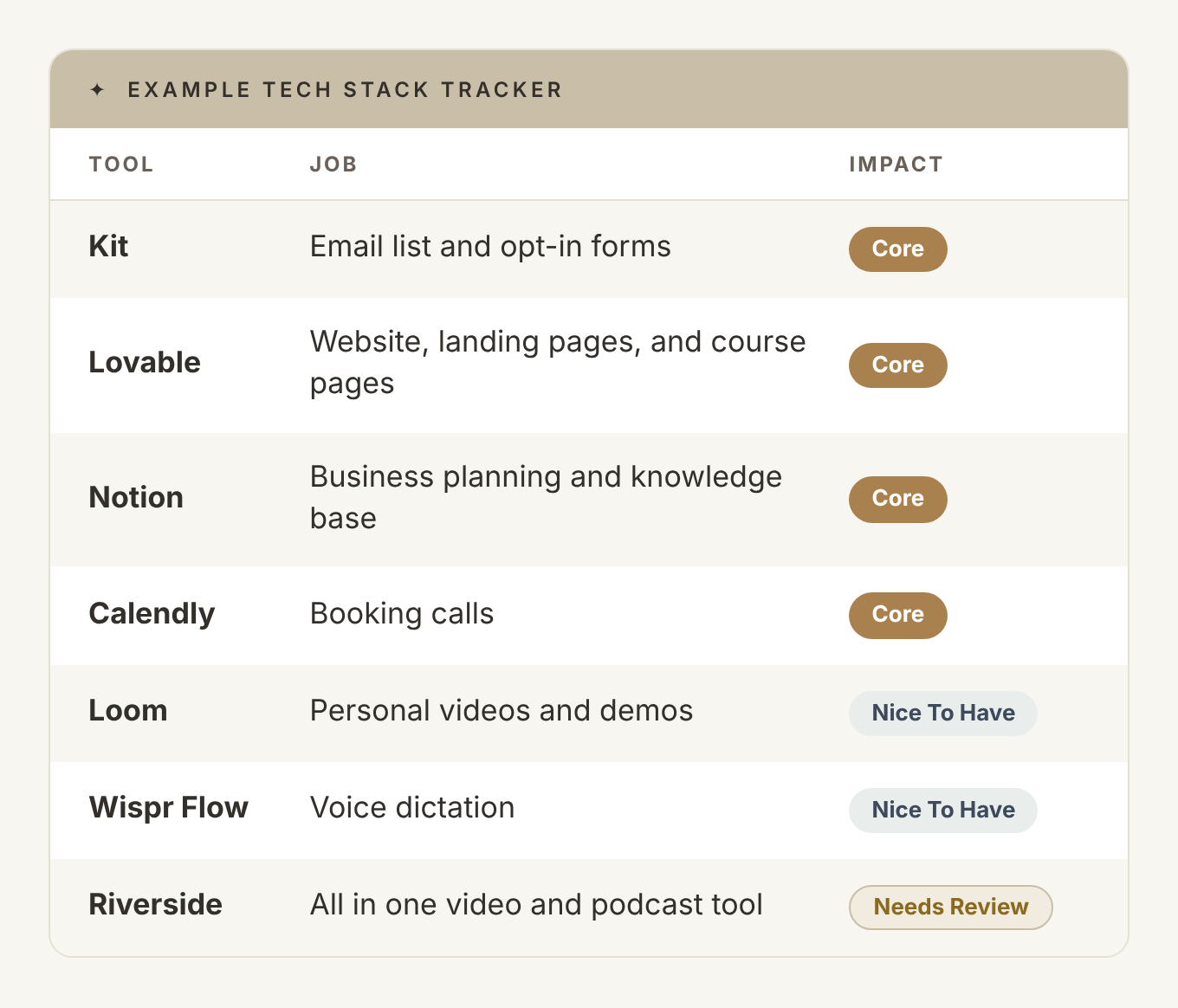
Simplifying means knowing why each tool is there. A few questions to carry with you this week:
Seeing your tools clearly is a great first step. What you do next depends on how you naturally follow through, and that looks different for each of us. My free Implementation Style quiz shows you yours in a few minutes, so you can choose tools and plans that fit you.
Free. Takes 2 to 3 minutes, and your result comes to your inbox.
Sustainable Workflows
When you work without a team, every task lands on you. Tie your list to a 90-day goal and a weekly focus, and your week feels lighter.
Read The PostProductivity
Some weeks leave you wondering what you worked on. Here is my real Sunday ritual, plus how to build a weekly reset and planning ritual of your own.
Read The PostProductivity
Busy all week but not sure what moved forward? Here's how to see your progress across marketing, sales, fulfillment, and CEO work, even on scattered weeks.
Read The Post