Systems
How To Build A Business Journal That Feels Like You
Build a business journal that feels like you. See how I used what I know about myself to design a journaling system, plus questions to find your own.
Read The PostProductivity

You have a lot of good ideas. That means you see what's possible for your business. It can also make picking the next one hard.
When everything feels important, it's easy to spend your best hours deciding instead of doing. A long list just needs a filter.
To decide what to focus on next, start with your 90-day goal. Then check your season, make sure your core basics are in place, and ship a first version. Psychologists Edwin Locke and Gary Latham summarized 35 years of research and found that specific, difficult goals led to higher performance than telling people to "do your best" (American Psychologist, 2002). A clear goal gives every choice a filter.
Your season is the mix of where your business is, what's going on in your life, and how much capacity you really have. Those three things decide what fits this month.
Ask yourself:
Am I building a foundation, growing, or scaling?
Is my life packed, steady, or changing?
How much time and energy do I really have this week?
Growth or scale is part of the answer, but only one part. Your life and your capacity belong in it too. A coach in a calm season might build a new offer. A coach in a packed season might polish one thing she already has. The habits, routines, and systems that fit now don't have to be the ones you use a year from now.
Does my season have to stay the same?
No. Seasons change, and your focus gets to change with them.
Your 90-day goal is your north star, and everything else feeds it. Your months feed the goal. Your weekly focus feeds your months. Your daily to do list feeds your week.
"Goals are good for setting a direction, but systems are best for making progress."
Your 90-day goal sets the direction. Your weekly focus is the system that makes progress.
Real life will still happen. You'll tweak the plan, move a day, or take a smaller step. When the goal stays put, every tweak still points the right way.
Locke and Latham also found that goals direct attention and effort toward the work that matters, and that people need feedback showing their progress. That's why a quick weekly look back matters. My post on how to build a business journal that feels like you shows one way to do it.
What if I don't have a 90-day goal yet?
Pick one big thing you want to happen by the end of the quarter. Make it specific enough that you'll know when it's done. For example, "sign 3 new clients by the end of the quarter."
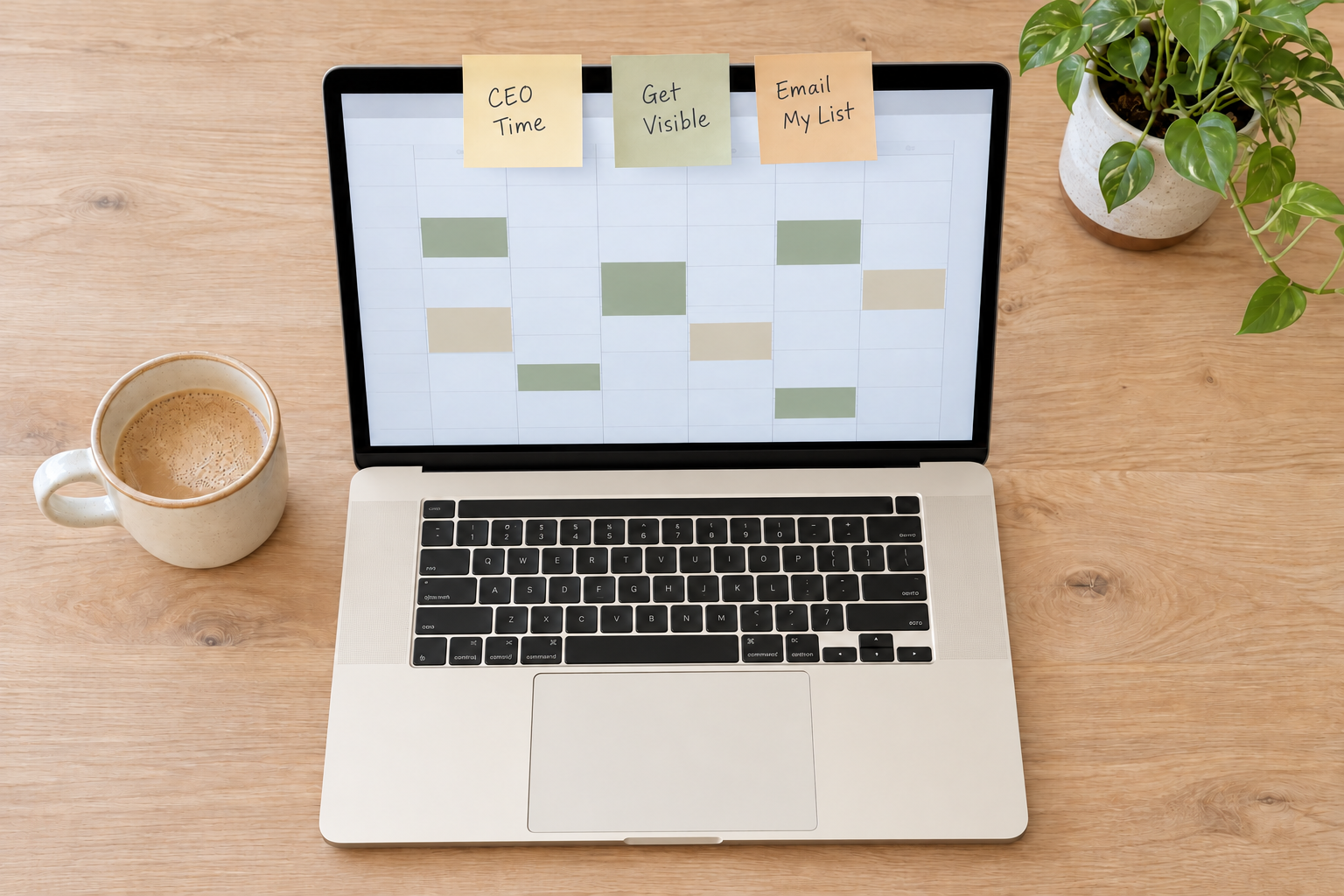
Your business runs on four core functions: marketing, sales, fulfillment, and CEO work. Think of them as the four departments of your business. Check that each one has a basic version in place before you move on to shinier things, or before you make something you already built fancier.
Getting visible so people can find you. You show up in front of new audiences to meet your people.
For example, a weekly email, a blog post, or a collab with another coach's audience.
Turning opportunities and conversations into clients. This is your offers, and how you convert leads into buyers.
For example, a clear offer page and an easy way to book a call or buy.
Showing up for your clients and wowing them. Happy clients refer more people, which grows your business.
For example, a warm welcome email, a great first session, and asking for a referral.
Working on your business, not just in it. You improve a core system, plan, sharpen your skills, and keep learning.
For example, a weekly planning hour, a smoother client onboarding, or a course that sharpens a skill.
A basic version out the door usually does the job.
What about my shinier ideas?
Keep a list. They aren't gone. They're waiting for their turn.
Ship the minimum viable version, then improve it later. Eric Ries, author of The Lean Startup, describes a minimum viable product as the version that lets you learn the most about your customers with the least effort. LinkedIn co-founder Reid Hoffman puts it more boldly:
"If you're not embarrassed by your first product release, you've released too late."
— Reid Hoffman, LinkedIn Co-Founder
For a coach, that could be a simple offer page, a short welcome email, or the first outline of a program.
Researcher Piers Steel combined 691 sources in a 2007 meta-analysis (a study of many studies) in Psychological Bulletin. He found perfectionism is not the main cause of putting things off. Lower confidence in finishing was a key driver. A small first version is a quick finish, and finishing builds that confidence.
I spent my first few months in research mode, and it kept me stuck. I was told to start that way, so I did. I obsessed over my niche, my messaging, and how I presented myself. I stayed in analysis paralysis.
Then I got to the exciting part. I built my offer and got my systems ready to sell it. I fell into the same loop and made it more complicated than it needed to be.
Now I ask, "Is it good enough?" If it's still doing its main job, it's ready. I can always come back to make it prettier or add extras. Shipping today doesn't mean I never touch it again.
No. Nothing in your business has to be permanent. We can take our decisions too seriously. We put so much weight on what we create and what we do next. Taking that weight off helps you move forward.
You're the chief everything officer. You can change your offers, your messaging, your website, or your branding at any time.
Work on the business you have today. That's the one in front of you. Getting ready for the business you might have a year or two from now is where overthinking grows, and it keeps us stuck.
Your season decides how you do the work. Your main focus stays the same. When I worked full time, I clocked into my job first. My business got my attention after I clocked out, while I was also making dinner and getting the kids to bed. I don't do my best work in the evening, and it was a hectic time. So I worked evenings and weekends for that season, in smaller pieces.
Now I'm not working full time, and my routine has changed. I can work when my brain is freshest, in a creative flow before the baby wakes up. I'm still finding my new flow. I lean on theme days now. Monday is content day, so all I focus on is content.
There's no right or wrong way to set your boundaries. Maybe you keep business off your phone. Maybe you skip weekends or evenings. Those non negotiables (the things that stay true no matter what) are yours. Need help choosing them? Try my post on weekly non-negotiables for coaches.
What if my season is packed right now?
Keep the same focus and do it in smaller pieces. If your focus is a sales page, write one section a day. Small progress still counts.
Choose the one next step that moves your 90-day goal and fits your season. Try this:
I made the Morning Coffee Brief to keep your focus in front of you every day. It's a Claude skill that gives you one page each workday with your focus, your core things, and what's on your calendar. It ends with a check in on you. How are you feeling? Do you need to tweak anything? You can always change your plan. It's $47, one time.
What would feel good to ship this week?
The Morning Coffee Brief is a Claude skill that gives you one page each workday with your focus, your core things, and what's on your calendar. It ends with a check in on you.
$47, one time.
Systems
Build a business journal that feels like you. See how I used what I know about myself to design a journaling system, plus questions to find your own.
Read The PostProductivity
A short list of weekly non-negotiables tells you what to do first, even in a busy, uncertain season. Here is how to pick yours.
Read The Post